
Sentence Mining: The Technique, and When It Actually Works
Sentence mining is the practice of pulling sentences from real native content, books, shows, podcasts, manga, and turning the ones you almost understand into flashcards. Instead of memorizing a word on its own, you memorize it inside a sentence you actually want to understand.
It comes out of the Japanese immersion community (AJATT, Refold, MIA) but works for any language. Done right, it's one of the most effective vocabulary techniques there is. Done at the wrong time, it's a slow, frustrating way to quit. Here's both sides.
The Core Idea: i+1
The whole technique rests on one principle, borrowed from linguist Stephen Krashen: i+1. You take a sentence where you know everything (i) except one thing (+1), one unknown word or one unknown grammar point. That single gap is what you learn.
The reason i+1 matters: a single unknown in a familiar context is something your brain can actually resolve. The surrounding words tell you the part of speech, the register, and roughly what the word means before you even check the dictionary. That context is what makes the word stick.
Why Sentences Beat Isolated Words
Learning "昼ご飯 = lunch" on its own gives you a fact. Learning it inside 友達とレストランで昼ご飯を食べた gives you the word plus everything around it:
You learn the meaning. You don't learn how it's used, which particles attach to it, or what it sounds like in a real sentence.
You learn the meaning, the natural collocation, the grammar, the rhythm, and the pronunciation, all at once.
A sentence card teaches you four things at the price of one:
The Traditional Workflow
Classic sentence mining, the Anki way, looks like this:
Tools like Yomitan, ASBPlayer, and Migaku exist precisely because steps 3 and 4 are tedious. Even with them, mining a single good card takes a minute or two of fiddling: looking up, formatting, grabbing audio, editing the Anki note. The payoff is real, but so is the friction.
It Works Best Once You Have a Base
One thing the immersion crowd doesn't always spell out: sentence mining gets much easier once you've got some vocabulary under your belt.
The technique depends on finding i+1 sentences, ones with a single gap. When you start from zero, most native sentences are closer to i+5 or i+10, so there's less familiar context to anchor each new word to. Mining still works at that stage, you just spend more time hunting for sentences you almost understand. A small base vocabulary changes that completely: suddenly clean i+1 sentences are everywhere.
Share of native sentences that are minable (i+1)
Illustrative. The point: a base makes clean i+1 sentences far easier to find.
Sentence mining really hits its stride once you have 500 to 1,000 words of base vocabulary, enough that real sentences usually have just one gap. The fastest way to get there is to learn the most common words in frequency order, then start mining as native content opens up to you.
The Smarter Sequence
Frequency first, mining second. They're not competing techniques, they're stages.
The base gets you to the point where native content is mostly comprehensible. From there, mining is fast and fun, because nearly every sentence you meet is a clean i+1.
How Vocabcraft Fits
You can do it right inside Vocabcraft. Paste in a word or a whole sentence you mined from a show or a book, and AI generates the rest: meaning, reading, furigana, audio, and an illustration. The card drops straight into the same spaced-repetition flow as everything else.
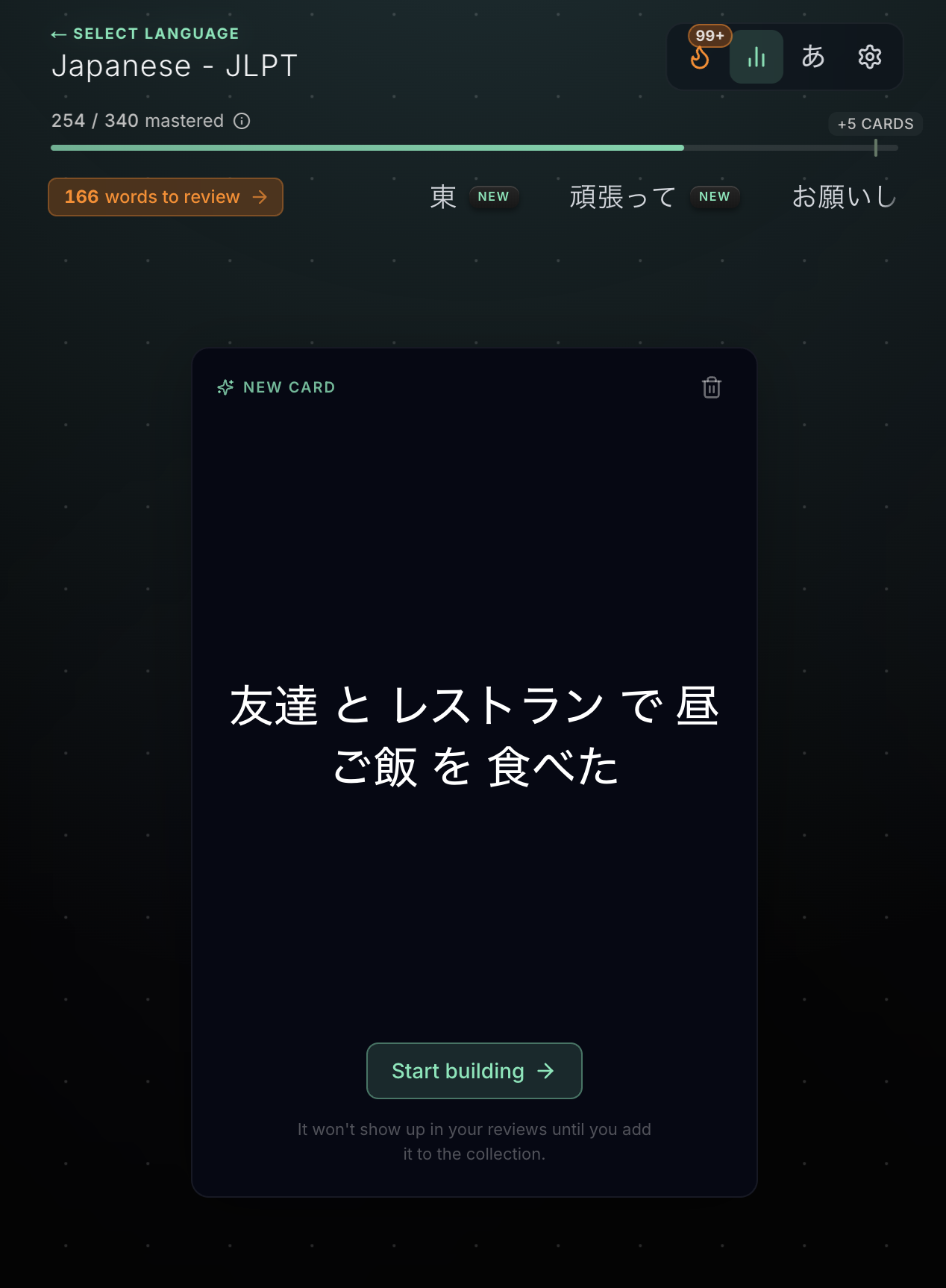
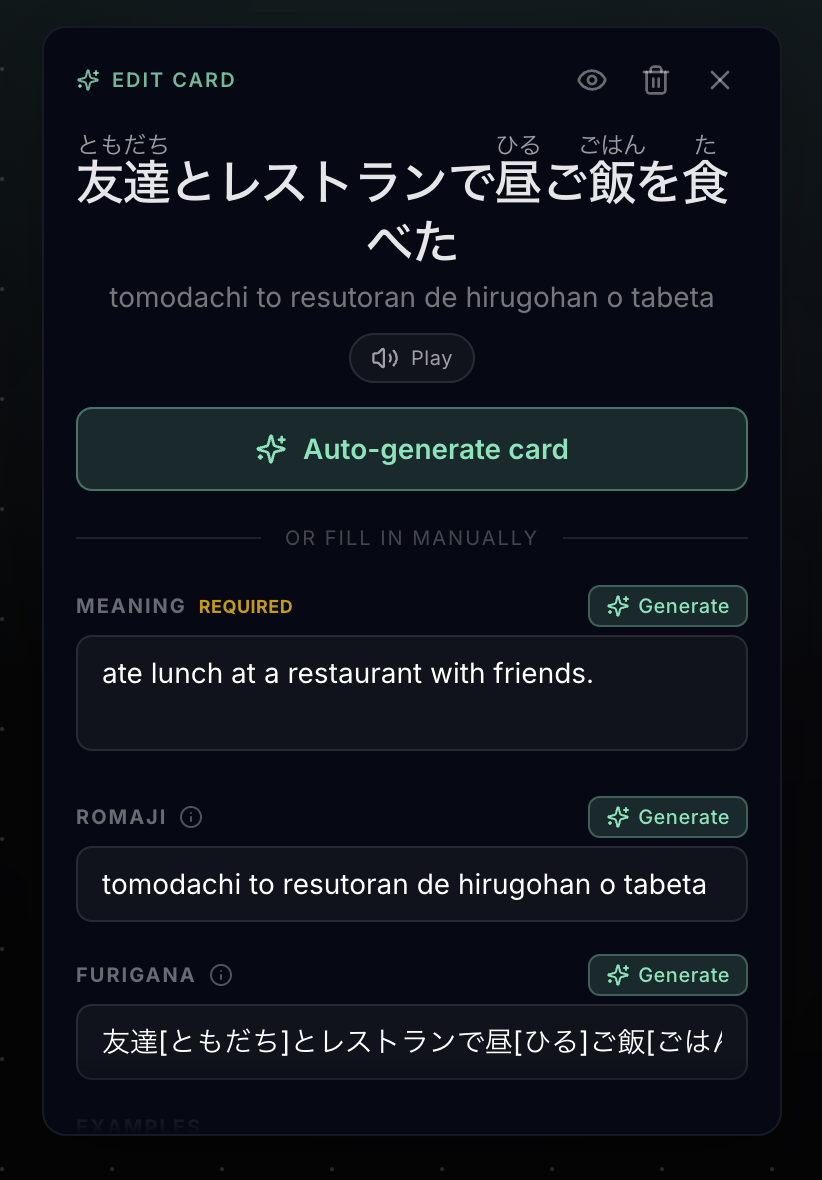
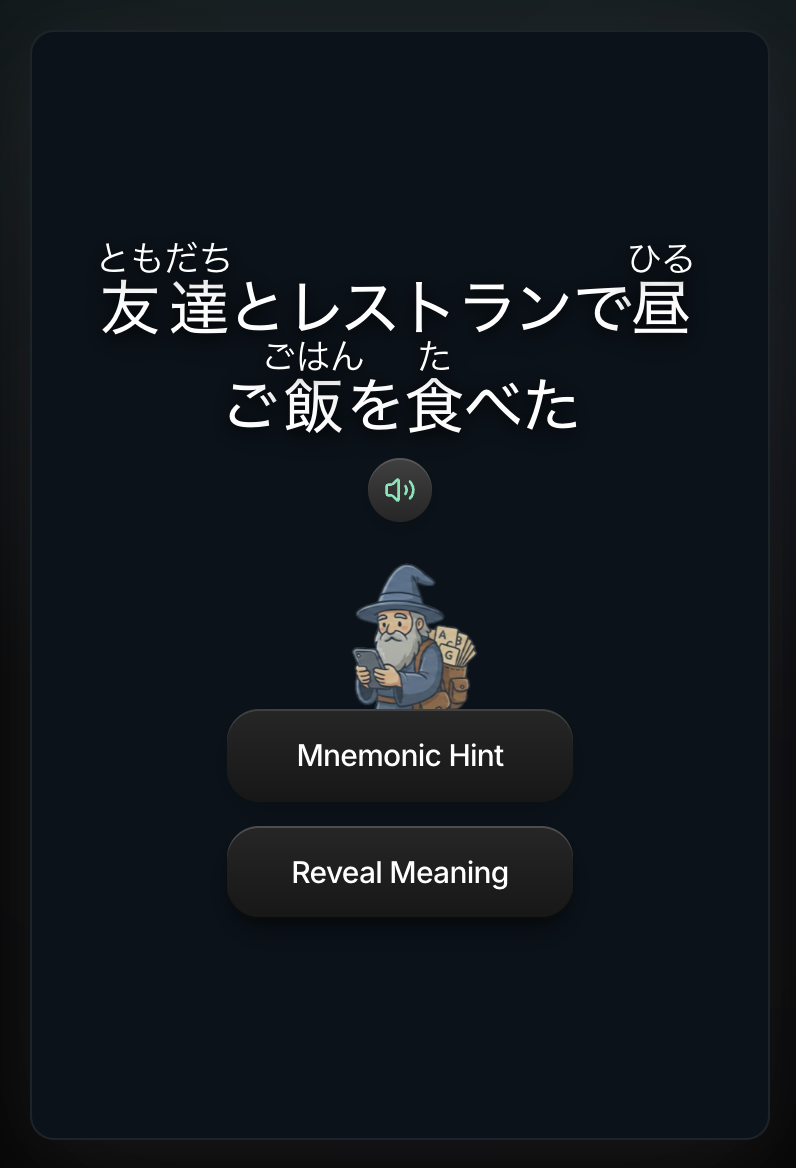
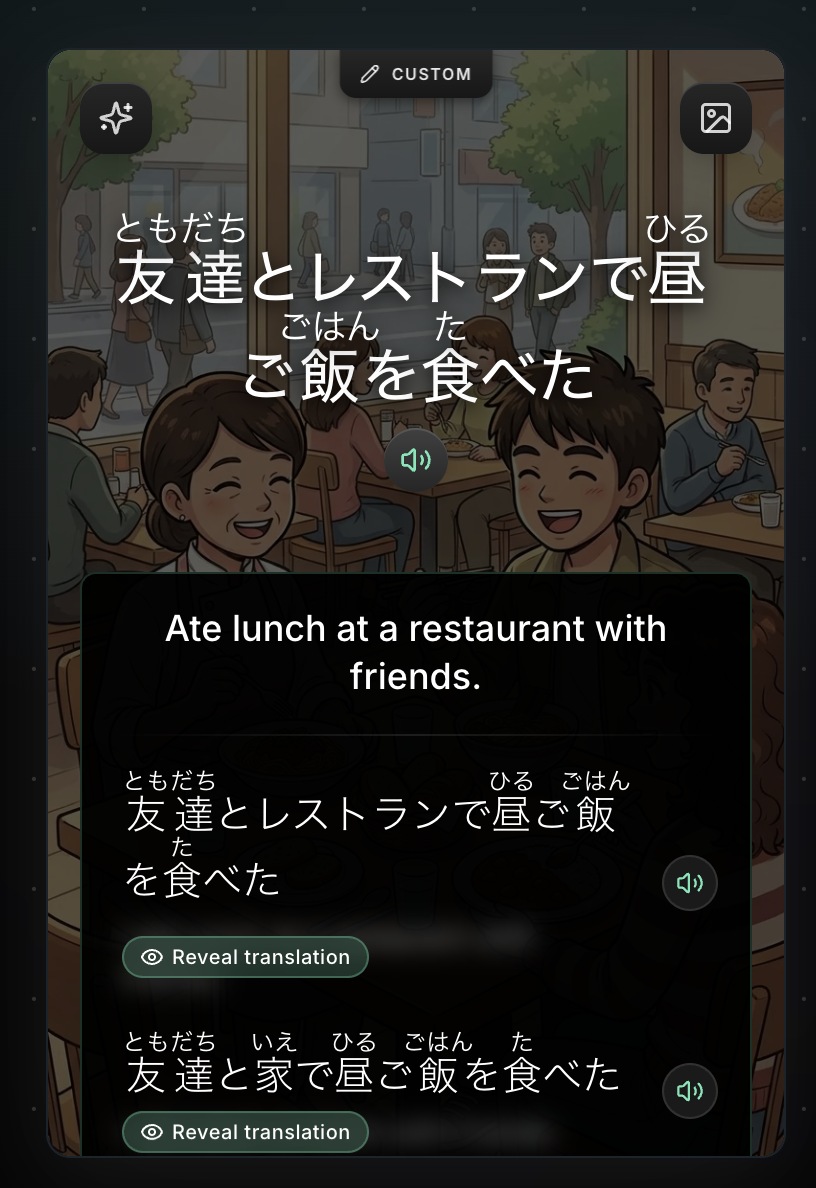
Build your base with Vocabcraft, then layer your own mined sentences on top as native content opens up. Frequency foundation and real-world mining, in one place.
Further reading: Why Frequency-Based Learning Works